Some more scattered thoughts.
In the previous post I wrote about changing the dialogue banks from 16-bit to 32-bit offsets. This worked, but it was apparently not free. The larger message area I added for the wide dialogue offsets lives in BSS, so it takes away memory before the game’s heap gets a chance to use it.
I had started getting crashes after playing for a while. The immediate failure looked like a font problem: a widget tried to create another set of rendering surfaces, received a null pointer, and carried on using it. The font was mostly innocent. Looking at the allocator showed that there was simply no heap left.
Later PSP models have more memory, and a game can request it with MEMSIZE=1 in
PARAM.SFO. PPSSPP supports this, so I added the option to translated builds,
cold-booted the game, and tried the same scene again.
It still crashed.
MEMSIZE made the extra memory available, but the game was not actually using
it. Its C runtime still reserved a fixed 17 MiB heap in the UserSbrk block it
uses for dynamic allocations, exactly as it did on the original PSP memory
layout. The remaining memory was sitting there untouched while the allocator
returned failure.
I found the heap-size value in the executable and increased it to 49 MiB. That keeps the game’s original 17 MiB and adds the extra 32 MiB made available by the later PSP models. After rebuilding and cold-booting again, the crash was gone. I have not reproduced an out-of-memory failure since.
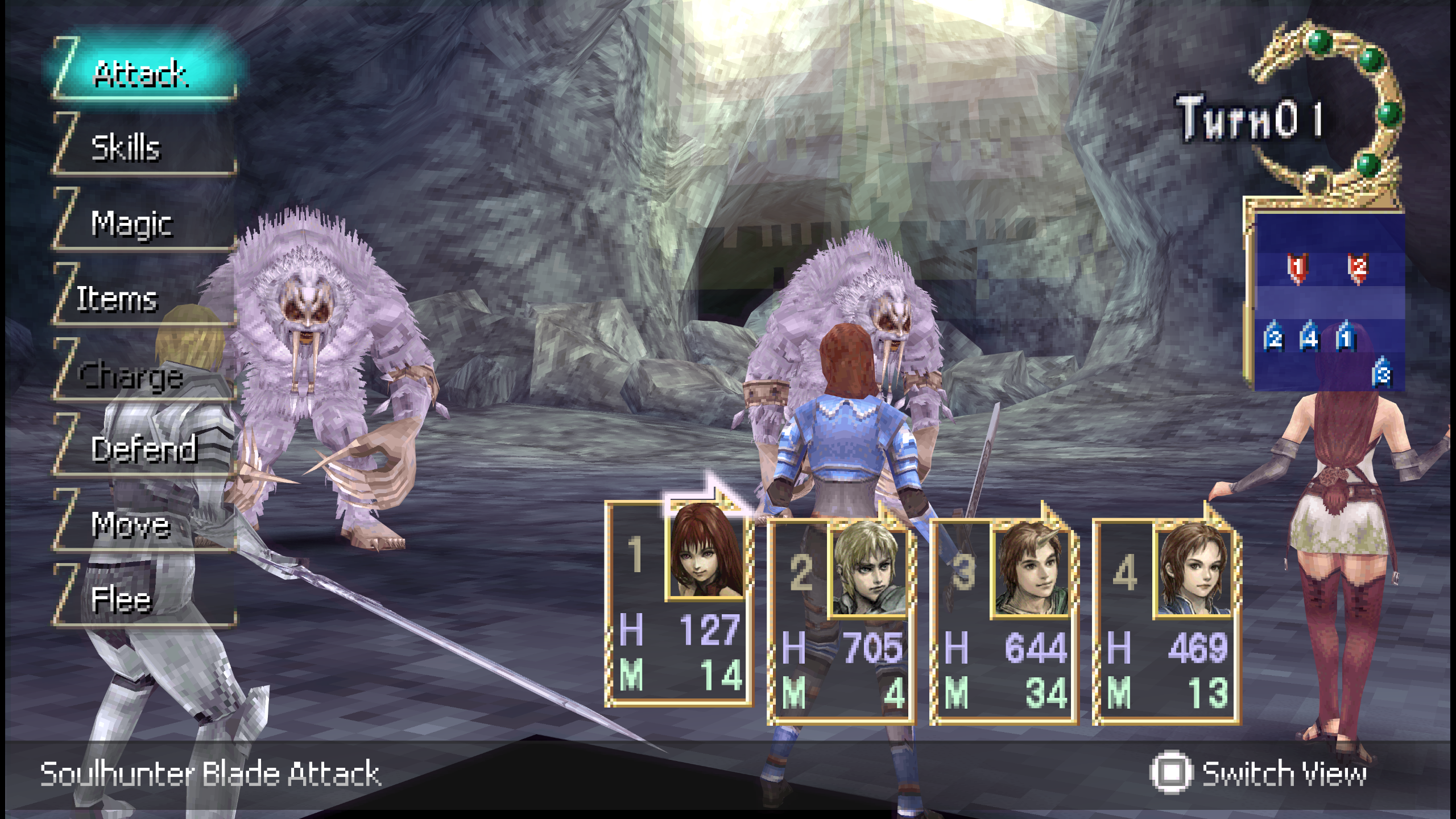
Combat in the translated build.
I can’t prove that this is why the developers used 16-bit dialogue offsets, but the game is tight with memory in more places than one. Making the message banks larger does not make all of the smaller buffers that receive their text any larger.
One guild-board posting produced a particularly strange failure. The list of jobs looked correct when I opened it, but after accepting one, all of the row text disappeared. The labels were still present and correctly formatted in memory, so I spent quite a while tracing the list refresh and state machine.
The actual corruption had already happened before I accepted anything. The posting was copied into a 316-byte buffer, but the expanded English text used 340 bytes including its terminator. Those extra 24 bytes landed in the beginning of the adjacent guild-list UI node. The list initially survived, then fell apart when the acceptance path tried to relink the corrupted node.
Finding the tail of an English sentence where a set of pointers should have been was a fairly good clue.
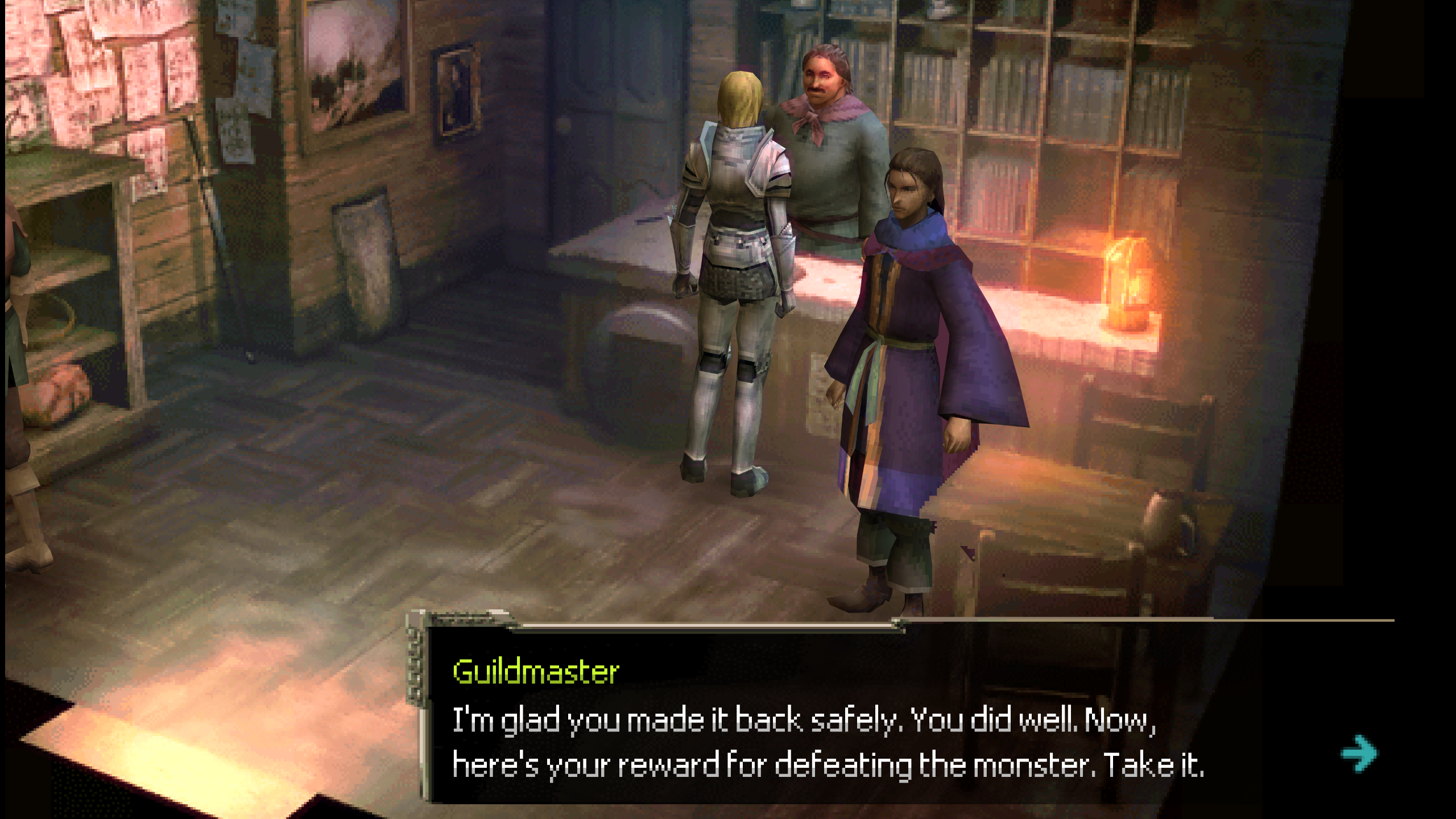
Reporting a completed quest to the Guildmaster.
I added the real 316-byte limit to the translation validator. The postings also contain runtime substitutions for item names, monsters, destinations, and numbers, so checking only the literal translated text would not be enough. The validator now uses the longest value that can appear for each substitution and checks that case.
It found 53 guild postings that could overflow the same buffer. I shortened and reflowed all of them; the largest remaining worst case is 286 bytes plus its terminator, leaving 29 bytes of headroom. This is much nicer than waiting for another menu to turn into part of a sentence.
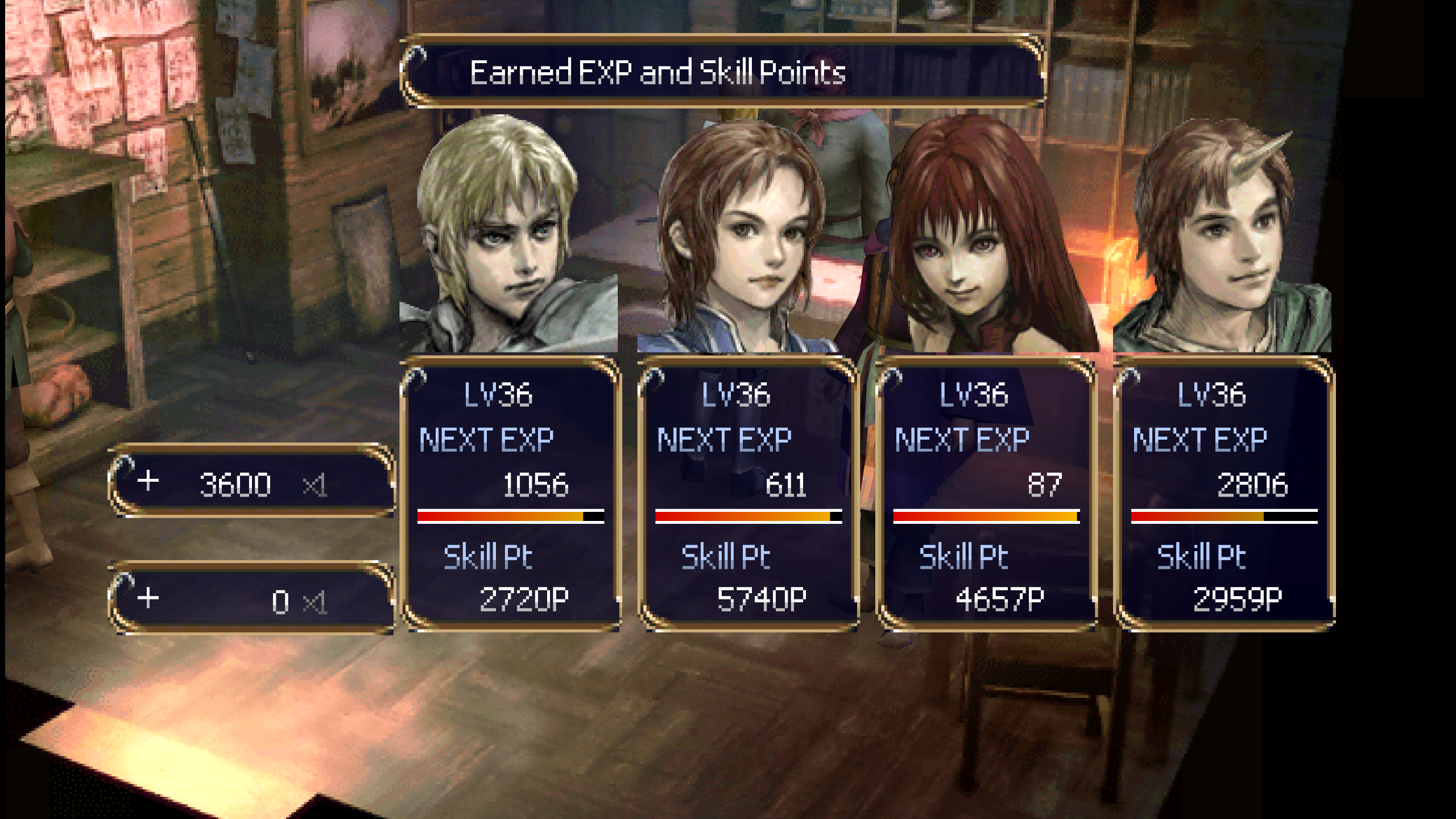
Quest rewards in the translated build.
The font is also no longer… not good for English.
The game uses a proportional bitmap font stored in 15×15-pixel atlas cells and renders it at native scale. That is enough room for the original glyphs, but not much room for an arbitrary desktop font. A replacement can look fine in a large preview and immediately become blurry, too wide, or both on a 480×272 screen.
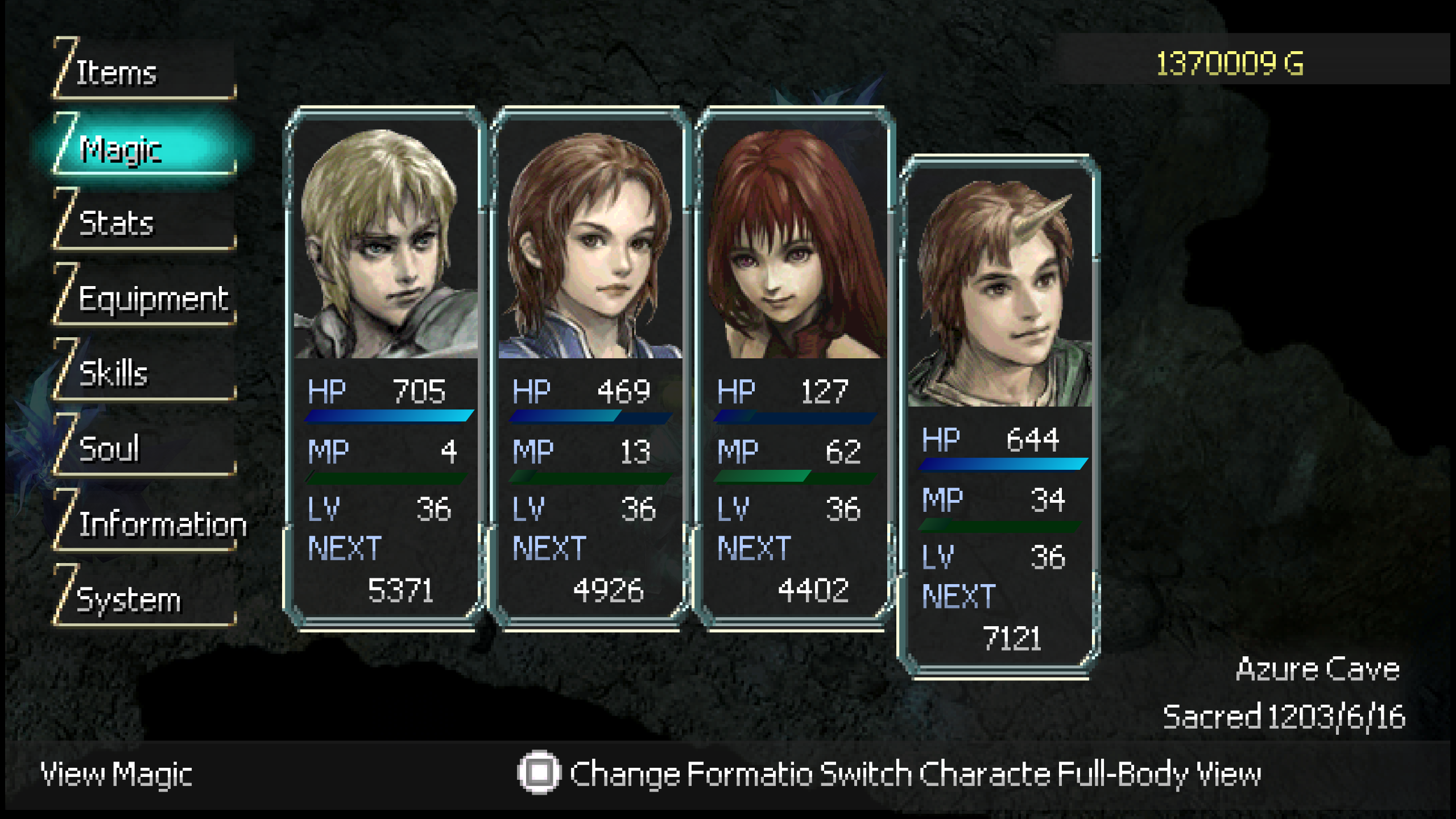
The party menu, showing the translated UI and replacement font.
I made a small pipeline to rasterize ordinary fonts into the game’s format and tried several of them in PPSSPP. Ubuntu Condensed and Roboto Condensed were promising. PixAntiqua looked nice, but used too much horizontal space once it was in the actual UI.
I eventually went back to Tahoma, rendered at 16 pixels per em (PPEM). It is not an exciting choice, but it is compact, readable, and looks appropriate for a PSP game. The replacement is now part of the normal build, so I do not have to reinstall it every time the game is rebuilt.
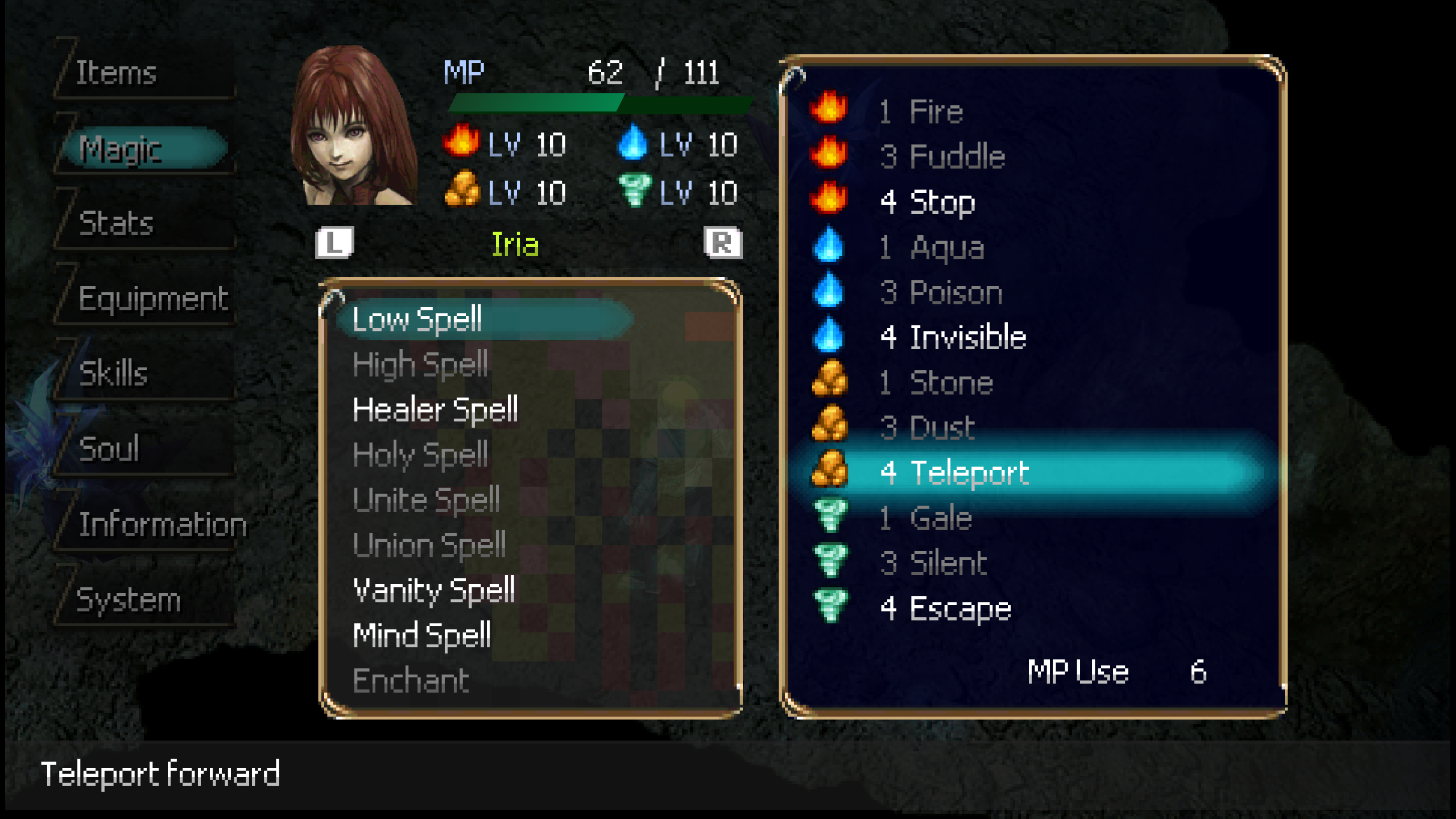
Selecting a spell from the character Magic menu.
While tracing the guild overflow, I also found the game’s own implementation of
strcpy at 0x21fd30. It is a small byte-by-byte copy that stops at NUL and has
no idea how large its destination is. There are 309 direct calls to it across
117 functions. Plenty.
I have not audited all of those calls yet. The useful approach is probably to work through them one by one: find each destination and its capacity, figure out which translated strings can reach it, and add each verified limit to the build validator. I may also log some of the copies in PPSSPP while working through them, but finding the function is not the same as proving every caller safe.
Overconfidently, I’d say I’m not too far away from being complete. I’ve played about ten hours of the current build, and most of what I am finding now is odd wording, untranslated text, or another very specific UI limit. There is still plenty of QA left, but it is starting to feel like a game I could actually hand to someone.
I’m sure the next menu will punish me for writing that.